#1
LET’S READ!
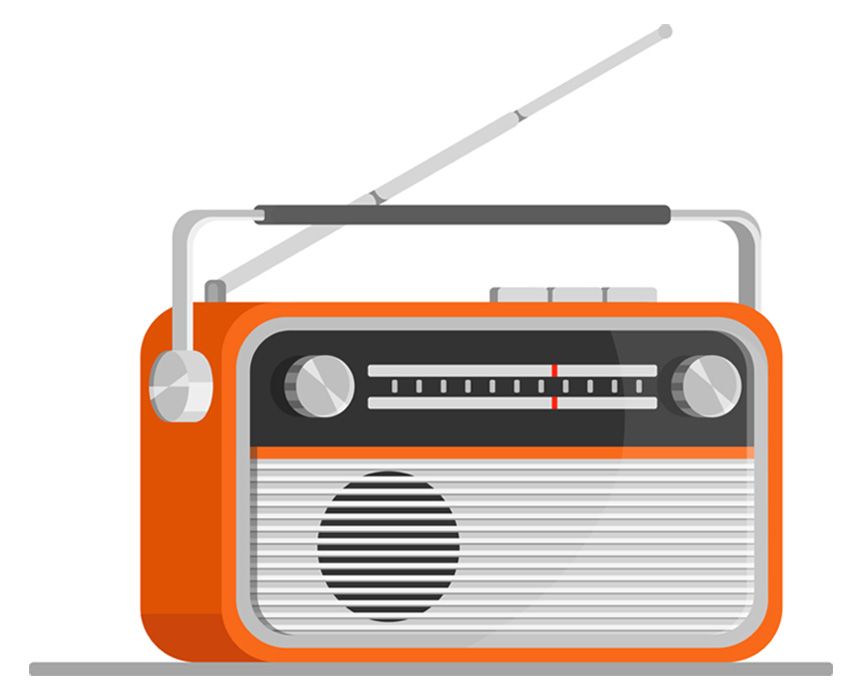
The radio is something that allows us to listen to music and conversations that are happening miles and miles away. They do this by picking up “radio waves.” These waves are transmitted from a radio station and picked up by antennae made to pick up those waves in our cars or homes. These radio waves are invisible; we can’t see or feel them. And cell phones also use radio waves to allow us to talk to our loved ones from far away! Once those radio waves reach our radios or phones, electricity and technology move them to the speakers, where they become sound that we can hear.
Radios come in lots of forms. We can hear what radio stations are transmitting on the radios in our homes, but also on the radios in our cars and even our phones. Nowadays, some radio stations have apps you can download so you can listen to their broadcast without using an actual radio!
LET’S TALK!
1. What does the radio do?
2. What do you like about the radio?
3. Do you listen to the radio every day? Why or why not?
#2
LET’S READ!
The very first radio waves that carried voice and music signals were transmitted in December of 1906, just over 110 years ago. These signals were heard in Boston after a Canadian experimenter named Reginald Fessenden made an hour of talking and music for people to listen to. This was done on Christmas Eve! It was a one-off experiment, and many more like it happened over the years, but it took a while for the radio to become a regular service with scheduled shows like we have today. A man named Charles Herrold was the first one to provide regularly scheduled voice and music programs to a small local audience, and that didn’t happen until 1908.
In the time before World War I, the radio grew in popularity. It seemed magical to people who had never experienced it before! Still, only a few people heard the broadcasts, and others just heard about them. Radios that plugged into the wall and used speakers to display the sound to the entire audience didn’t become popular until after 1927. But the government restricted the use of radio during World War I, so that paused the growth of the system for a while.
LET’S TALK!
1. What’s your favorite thing to listen to on the radio? Why is it your favorite?
2. Are you grateful for the radio? Why or why not?
3. Do you like the music and/or conversations they play on the radio?
#3
LET’S READ!
There are two different kinds of radio: AM and FM.
AM radio is reserved for conversation and talking. Sometimes people talk on FM, too, but talk shows are done on AM radio. On these shows, they talk about certain subjects and allow people to call in and add to the conversation.
FM radio, on the other hand, is for music! Sometimes the people deciding what music is played will talk to advertise products or promotions the radio station is doing, like giving away tickets to the 100th person who texts the radio station and stuff like that.
Radio has evolved from a source of information to a source of information as well as entertainment. You can find updates on the political climate on the radio, as well as information on current events like car crashes or traffic delays. But you can also find all kinds of good music and entertaining podcasts. There are certain stations for different kinds of music, like a country station, a pop station, a rock station, and more.
LET’S TALK!
1. Do you like listening to the radio while you work or clean?
2. What are your favorite radio stations? Why are they your favorite?
3. Have you been to a radio station before?
#4
LET’S READ!
Want some radio fun facts? Here they are!
Back in the 1980s (which was only 40 years ago!), people could download video games from a radio broadcast. If they recorded the sound onto something called a cassette tape, they could later play the game on their computers.
The first public radio broadcasts were done in 1908 on top of the Eiffel tower! He played some music for the people of Paris and subsequently became the first radio DJ. Not only that, but the Eiffel Tower was going to be brought down after twenty years, but it survived because the military used it as a radio tower to receive extremely important military transmissions during World War I.
Additionally, scientists believe that radio waves continue to travel forever unless something absorbs them. If that’s true, then it’s possible that alien life forms in space or on other planets might’ve heard the radio waves coming from earth (if you believe in aliens!).
In 2005, a radio station sampled 3,500 music fans to make “rock’s ultimate supergroup.” They chose the best musician of all time for every musical instrument and ended up forming a very famous band called Led Zeppelin!
LET’S TALK!
1. If you are old enough to remember, talk to your child about the shows you used to hear on the radio.
2. Do you like that the radio plays popular songs or do you wish that they would play lesser known stuff?
3. Tell your child about modern-day radios on your phone like Spotify or Pandora radio. How are these radios different from the radio in your car or home?
VOCABULARY WORDS:
waves, science, volume, sound, music, talk show, radio show, host, artists, songs, new, music, stories, listen, settings, change, search, dials, batteries, electronic, technology, radio, Pandora
ACTIVITIES:
• If you have a radio around the house, show it to your child. (If it’s hidden away or if you only have one in the car, find the radio and show your child). Let them see and touch the different dials and settings and play with the controls. Describe what each feature is for, from the antenna to the speakers to the display.
• If you don’t own a radio, take a trip to the local Goodwill or thrift shop and see if there are any radios there that you can explore with your child–or even buy!
• Because a radio is not what it once was, consider creating a free account on Pandora here for each of your children, or you can help them create their own new station on your own account. Pandora offers stations like Toddler Radio, KIDZ BOP, Disney Radio, and Children’s Indie Radio (which plays child-friendly songs from adult artists).
• Play the radio freeze game. Turn on a radio station and have your child dance to the song, then when the song stops (you can either pause it or turn down the volume), have your child freeze. When you press play again, they can keep dancing. You could also use this method to play musical chairs!
• Turn on music without words, like classical or nature sounds. Prepare paper, paints, glue, and other art supplies, then have your child create a picture of what they hear. Sit next to them and create your own artwork of what the music makes you think of. When you are finished, talk about the song and the art with your child.
RESOURCES:
1. Dr. Panda’s on the radio (YouTube Video)
2. HOW RADIO WAVES WORK – Science at Home (YouTube Video)
3. Great Innovators: Marconi and the Radio (YouTube Video)
4. Radio Man/Don Radio (A story in English and Spanish) by Arthur Dorris (Rayo, 1997)
5. Radio Rescue by Lynne Barasch (Farrar, Straus and Giroux, 2000)