#1
LET’S READ!
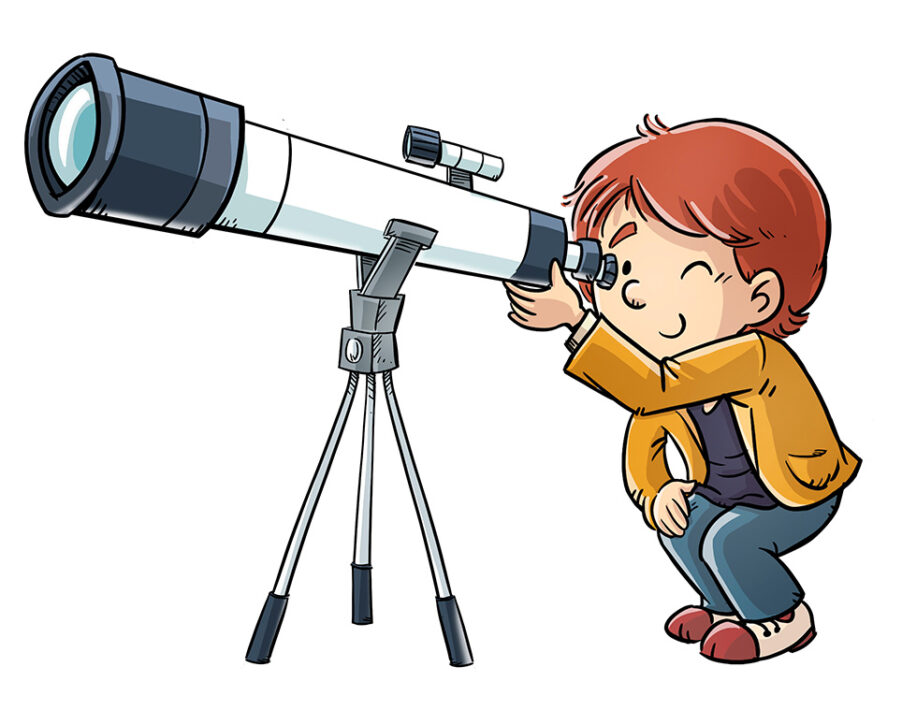
All the way back in 1608, people began using a tool to see the stars in the sky better. This tool is called a telescope, and the first one ever was officially invented 400 years ago in 1617. Back then, telescopes had pieces of curved, clear glass called lenses that focused the light entering the telescope. Today, we typically use curved mirrors because they’re lighter and easier to smooth out than glass. Reflector telescopes use mirrors, while refractor telescopes still use glass. These mirrors and glass are called the “optics,” and their shape determines what we see through the telescope. When we look into a telescope, that’s the light we see!
Some telescopes can see things that are very dim or very far away. To do that, the optics in a telescope have to be very big. That’s why some telescopes are bigger and more powerful than others. Not only that, but the optics of a telescope have to be nearly perfect–they have to be the right shape and they can’t have spots, scratches, bumps, or any other issues. If the optics do have any of those things, the image they show us gets warped, blurry, and harder to see. Making the perfect optics for a telescope is difficult; the people who do it are very talented!
LET’S TALK!
1. Have you ever used a telescope? Did you like it? Why or why not?
2. Do you like looking at the stars?
3. Do you think telescopes are helpful? Why?
#2
LET’S READ!
Telescopes are mostly used for observing outer space, but they can also be used to see things that are far away on earth and for taking photos of both of those things!
The main purpose of a telescope is to look at outer space, and the people who do this for scientific reasons are called astronomers. People who own telescopes for fun can also do this whenever they want; we call them hobbyists. Telescopes allow us to see satellites, planets, stars, constellations, comets, asteroids, and moons that are very far away. Using a telescope to see outer space and what’s inside it allows us to study these things and to learn about our universe, but also to just appreciate them for what they are!
Using telescopes has taught us so much about what’s in outer space around us. We’ve learned that the universe is 14 billion years old and is a lot bigger than we used to think it was, and we’ve seen things like black holes and supernovas that we would never have seen with our eyes alone.
LET’S TALK!
1. Do you think being an astronomer sounds like a fun job? Why or why not? Explain to your child all the science that goes into studying outer space (like lots and lots of math and chemistry).
2. What would you use a telescope for?
3. What’s your favorite planet in our solar system? Have you ever seen it in the sky?
#3
LET’S READ!
Did you know telescopes are time machines? It’s true; light from the sun takes 8 minutes to reach the Earth, and light from the star closest to the sun takes 4.2 years to reach Earth! So when you look at stars, especially very distant ones, you’re seeing years and years into the past. In fact, it’s entirely possible that some of the stars you’re looking at have burnt out and fallen apart and no longer exist in outer space!
Remember how telescopes can be used to see things on earth? If you’ve ever used a pair of binoculars, you’ve used a smaller version of a telescope. These telescopes can be used for outdoor activities, navigation, and tourism.
For example, you can see a bird or animal in the woods better than you would with just your eyes. Those who like to bird watch, hunt, or take photos of wildlife sometimes use telescopes!
Telescopes can also be used for navigation, especially for vehicles on or in the sea like ships, boats, and submarines. They use these to find land, to know where they are based on the stars, and to see what’s in the water far away.
Finally, you’ll often find telescopes at tourist spots like the top of a mountain or the Space Needle in Seattle. Tourists love using these tools to see all of the new things around them!
LET’S TALK!
1. What would someone use a smaller telescope? What about a big one?
2. Have you used binoculars before? What did they help you see? If you haven’t used them before, what would you like to try and see with them?
3. Would you like to watch animals and birds in the wild with a telescope or binoculars?
#4
LET’S READ!
Let’s learn about some telescope fun facts!
The Hubble Space Telescope, or HST, was made by NASA (which stands for National Aeronautics and Space Administration) and launched into low orbit around the earth all the way back in 1990, and it’s still doing its job out in outer space! This telescope is 43 feet long and weighs 24,000 lbs. That’s as much as 6-8 cars! It also travels around the earth at almost 17,000 miles per hour–34 times faster than a plane!
One of the things telescopes were first used for in the 1600s was to spot the merchant ships approaching. This allowed whoever could see the ships to have the upper hand for trading.
Did you know there’s an Earth 2.0? That planet was discovered in 2015 using the Kepler telescope and is one of the planets we’ve ever found that’s most like Earth.
Have you heard of Jack Black? He played Nacho Libre in Nacho Libre and the legendary panda Po in Kung Fu Panda! His parents both worked as engineers on the Hubble Space Telescope!
LET’S TALK!
1. Do you think it’d be fun to work on a giant telescope?
2. Would it be cool if you were the first person to discover something important in space?
3. If you had a really advanced telescope, what would you do with it? What would you like to see? Would you observe the moon and its phases, or search the stars for hidden galaxies? Maybe you’d like to see something closer to home like an eagle soaring high in the sky. Talk with your child about it!
VOCABULARY WORDS:
lens, magnification, observation, discovery, view, light, science, space, constellations, stars, planets, colors, distance, sight, reflection, mirrors, technology, instrument, device, detect, search, look, image, telescope, spyglass
ACTIVITIES:
• Go outside and stargaze with your child. If you want, you can contact your local library to see if they have telescopes or binoculars available to rent–they often do! Either way, look at the stars with your child and talk about how far away they are and how some of them might not be stars anymore; they might’ve stopped shining or fallen apart.
• Have your child make their own telescope or binoculars. Empty toilet paper or paper towel rolls are perfect for this. Have your child decorate them with stickers, paper, and tape.
• With your makeshift telescope/binoculars, search for things around the house. Then take your tool to the store, the park, or on a car ride. Keep finding things and talking about them!
• Play I Spy with your child. Have them find an item with their telescope/binoculars and give you clues to what it might be. Take turns playing the game together!
RESOURCES:
1. Telescopes in Space! (YouTube Video)
2. How Hubble Works (YouTube Video)
3. How telescopes work (YouTube Video)
4. Let’s Explore Space! Astronomy for Kids (YouTube Video)
5. Habo Junior and His Grandfather’s Magic Telescope by Harald H. Ritzau (RoseDog Books, 2009)
6. Jake and the Neverland Pirates: Jake and the Spyglass by Melinda LaRose (Disney Press, 2012)
7. The Sailor Dog (A Little Golden Book) by Margaret Wise Brown (Golden Books, 2001)